Aryan Paganism, Traditions and Art (APTA)
14 January 2026 01:34
Each city had its corps of priests, who depended upon no foreign authority. Between the priests of two cities there was no bond, no communication, no exchange of instruction or of rites. If one passed from one city to another, he found other gods, other dogmas, other ceremonies. The ancients had books of liturgies, but those of one city did not resemble those of another. Every city had its collection of prayers and practices, which were kept very secret; it would have thought itself in danger of compromising its religion and its destiny by opening this collection to strangers. Thus religion was entirely local, entirely civic, taking this word in the ancient sense — that is to say, special to each city.
Numa de Coulanges
Читать полностью…
Aryan Paganism, Traditions and Art (APTA)
12 January 2026 04:45
An example of christian revisionism of Pagan myth
"Some writers have labored to prove that this Prometheus, of the heathen Mythology, was a Scriptural character. Bochart believes him to have been the same with Magog, mentioned in the book of Genesis. Prometheus was the son of Iapetus, and Magog was the son of Japhet, who, according to that learned writer, was identical with Iapetus.
The fable of Prometheus being devoured by an eagle, according to some, is founded on the name of Magog, which signifies ‘a man devoured by sorrow.’"
Henry T.Riley
Читать полностью…
Aryan Paganism, Traditions and Art (APTA)
11 January 2026 19:57
Prometheus creating the first Man
30 BC ringstone
Читать полностью…
Aryan Paganism, Traditions and Art (APTA)
11 January 2026 10:21
Volodymyr Slepchenko
Читать полностью…
Aryan Paganism, Traditions and Art (APTA)
09 January 2026 08:00
^ Those Numa calls vulgar there are proper Pagans. Philosophers were first atheists and proto-christians. The idea of a universal God is as anti-Pagan as it gets. Our guys say that if every christian degenerate was nailed to a cross the world would be a better place. Well, if every philosopher was forced to drink hemlock there’d be no christians to begin with (or christianity would be just a minor sect of judaism).
Читать полностью…
Aryan Paganism, Traditions and Art (APTA)
09 January 2026 05:40
The city which possessed a divinity of its own did not wish strangers to be protected by it, or to adore it. More commonly a temple was accessible only to citizens. The Argives alone had the right to enter the temple of Hera at Argos. To enter that of Athene at Athens, one had to be an Athenian. The Romans who adored two Junos at home could not enter the temple of a third Juno, who was in the little city of Lanuvium.
Numa de Coulanges
Читать полностью…
Aryan Paganism, Traditions and Art (APTA)
08 January 2026 01:52
The image of Christ for those Norsemen who accepted him as a God seems to be far from the one current in the Christian world of that time. In skaldic poetry before 1050 as well as in pictorial art, he appears first and foremost as a strong and mighty ruler. The earliest depictions of him, such as that on the Jelling stone, portray him as triumphant and glorious. The notion of the suffering Christ was not conceived by the Vikings and ‘would have been regarded as almost absurd’ by them, although they could not have failed to see crucifixes with the suffering Christ in Western Europe and Byzantium.
E.Melnikova
Читать полностью…
Aryan Paganism, Traditions and Art (APTA)
07 January 2026 02:53
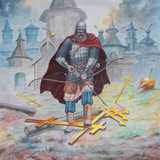
He left the treasure to close with his aggressor and the two engaged in a merciless struggle. Everything about them was smashed. The howedweller made a ferocious onslaught.
Читать полностью…
Aryan Paganism, Traditions and Art (APTA)
06 January 2026 04:12
A Gorgon’s head, or at least that of Medusa, has other unusual properties also. Displaying a lock of hair from a Gorgon can cause an army to scatter in fright, and Gorgon’s blood was used by the physician Asklepios sometimes to heal and sometimes to injure his patients.
W.F.Hansen
Читать полностью…
Aryan Paganism, Traditions and Art (APTA)
05 January 2026 07:32
^ the source was provided by @
Читать полностью…
Aryan Paganism, Traditions and Art (APTA)
03 January 2026 23:35
Ravens and wolves live in symbiosis. Like many scavengers, ravens depend on large predators to provide them with carcasses. It is theorized that ravens and wolves can even develop individual bonds.
Читать полностью…
Aryan Paganism, Traditions and Art (APTA)
02 January 2026 23:10
The cities of Argos and Samos had each a Here Polias, but it was not the same goddess, for she was represented in the two cities with very different attributes.
Numa de Coulanges
Читать полностью…
Aryan Paganism, Traditions and Art (APTA)
02 January 2026 10:43
Adamant
Fabulous metal of extreme hardness used by gods and heroes.
Adamant was created by Gaia, who made from it the sickle with which Kronos castrated his father, Ouranos.
W.F.Hansen
Читать полностью…
Aryan Paganism, Traditions and Art (APTA)
02 January 2026 00:15
A great number of cities had a Jupiter as a city-protecting divinity. There were as many Jupiters as there were cities.
Numa de Coulanges
Читать полностью…
Aryan Paganism, Traditions and Art (APTA)
01 January 2026 06:30
The names of Zeus, Athene, Hera, Jupiter, Minerva, and Neptune are better known to us, and we know that they were often applied to these city-guarding divinities; but because two cities happened to apply the same name to their god, we are not to conclude that they adored the same god. There was an Athene at Athens, and there was one at Sparta; but they were two goddesses.
Numa de Coulanges
Читать полностью…
Aryan Paganism, Traditions and Art (APTA)
12 January 2026 13:14
Relics of the veneration of the household natrix snake which lives in the hearth and brings luck are preserved in traditional Boykos worldview. This is evidenced by the next demonological story: I came to visit my aunt and saw a plate behind a curtain which the aunt filled with milk. I saw three snakes with convex, red eyes. The aunt said: "I have to feed them, otherwise my cows will die".
N.Voitovich
Читать полностью…
Aryan Paganism, Traditions and Art (APTA)
12 January 2026 04:26
Man was formed….the son of Iapetus fashioned after the image of the Gods, who rule over all things. And, whereas other animals bend their looks downwards upon the Earth, to Man he gave a countenance to look on high and to behold the heavens, and to raise his face erect to the stars. Thus, that which had been lately rude earth, and without any regular shape, being changed, assumed the form of Man, till then unknown.
The Metamorphoses of Ovid
translated into English prose by Henry T.Riley
Читать полностью…
Aryan Paganism, Traditions and Art (APTA)
11 January 2026 16:38
Creationism is more racist than racism
Paganism provides a much stronger case for separation of different people than any soyence, even the scientific racism common among right-wing atheists. That’s because Paganism rejects evolutionary theory completely. Different people are created by different Gods and have absolutely nothing in common. Meanwhile even the most racist soyence-worshipper still believes that all human races (and even humans and apes) have a common progenitor.
Читать полностью…
Aryan Paganism, Traditions and Art (APTA)
09 January 2026 09:47
Generally a man knew only the gods of his own city, and honored and respected them alone. Each one could say what, in a tragedy of Æschylus, a stranger said to the Argives — “I fear not the gods of your country; I owe them nothing.”
Numa de Coulanges
Читать полностью…
Aryan Paganism, Traditions and Art (APTA)
09 January 2026 07:54
Each of their innumerable gods had his little domain; to one a family belonged, to another a tribe, to a third a city.
As to the god of the human race, a few philosophers had an idea of him; the mysteries of Eleusis might have afforded a glimpse…but the vulgar never believed in such a god.
Numa de Coulanges
Читать полностью…
Aryan Paganism, Traditions and Art (APTA)
08 January 2026 03:59
Exclusively Christian characteristics of Christ that could not be correlated with heathen equivalents are hardly represented in sources even of the 11th century. Runic invocations never address Christ as the Saviour, nor do they reveal any knowledge of the concept of redemption. Both notions were basic tenets of Christianity in which Christ was first and foremost the Redeemer of the sins of mankind as well as of individuals.
E.Melnikova
Читать полностью…
Aryan Paganism, Traditions and Art (APTA)
07 January 2026 02:56
They did not spare each other. Soon they came to the place where the horse's bones were lying, and here they struggled for long, each in turn being brought to his knees.
Читать полностью…
Aryan Paganism, Traditions and Art (APTA)
07 January 2026 02:52
Grettir took all the treasure and went back towards the rope, but on his way he felt himself seized by a strong hand.
Читать полностью…
Aryan Paganism, Traditions and Art (APTA)
06 January 2026 04:11
The Gorgons, daughters of Phorkys and Keto, possess bodies like those of human women, snakes as hair, boar’s tusks, and wings. Whereas the Gorgons Sthenno and Euryalê are immortal and ageless, Medusa (Greek Medousa) was born mortal and perished when she was decapitated by the hero Perseus. Anyone who looks upon a Gorgon is transformed into stone, becoming in effect a statue.
W.F.Hansen
Читать полностью…
Aryan Paganism, Traditions and Art (APTA)
05 January 2026 07:28
Chort is as tall as a man. He looks like a wolf, but with horns, hooves and a [cow] tail. He usually lives under an oak or in a swamp. Chort is very afraid of Perun and hides from him everywhere. For example under trees. And then Perun shoots arrows at trees. That’s why you must not hide under trees during a storm.
V.S.Novak
Читать полностью…
Aryan Paganism, Traditions and Art (APTA)
03 January 2026 06:01
Firstly, I want to wish everyone a Happy New Year! This year we want to bring you deep-analysis & many guides for Pagan Revival!
Many folk who first get into Heathenry want to know what they should read to start their journey back home. There are three quick reads, packed full with great introductory information, which encompass most of the fundamentals of Heathenry. Though these are not the end-all-be-all, these are essential for every Heathen to read & meditate upon.
Below are the links to free versions & brief summaries of these books
1. Havamal (link): The words of Odin himself, Havamal gives the core morality expected of those who follow the faith.
2. Germania (link): Written by the Roman historian Tacitus, Germania gives an early look into the customs & of the ancestors who followed Heathenry in practice.
3. Voluspa (link): The words of a Volva (seeress) to Odin, Voluspa tells of what was, what is to come & a synopsis of Heathen theology.
Gods guide your footsteps on your great journey back home!
Читать полностью…
Aryan Paganism, Traditions and Art (APTA)
02 January 2026 23:06
The name of the deity is usually either a vocative or the object of the verbal predicate ‘Let me sing’. But a Greek deity can have many names …There can also be hesitation as to the appropriate choice of name by which the deity would like to be addressed, as in this well-known hymn to Zeus:
Zeus—whoever he may be, if it pleases him to be so called, then I address him by that name.
Christopher Metcalf
Читать полностью…
Aryan Paganism, Traditions and Art (APTA)
02 January 2026 00:20
There was at Rome a Juno; at a distance of five leagues, the city of Veii had another. So little were they the same divinity that we see the dictator Camillus, while besieging Veii, address himself to the Juno of the enemy, to induce her to abandon the Etruscan city and pass into his camp. When he is master of the city, he takes the statue, well persuaded that he gains possession of the goddess at the same time, and devoutly transports it to Rome. From that time Rome had two protecting Junos.
Numa de Coulanges
Читать полностью…
Aryan Paganism, Traditions and Art (APTA)
01 January 2026 06:36
In the legend of the Trojan war we see a Pallas who fights for the Greeks, and there is among the Trojans another Pallas, who receives their worship and protects her worshippers. Would any one say that it was the same divinity who figured in both armies? Certainly not; for the ancients did not attribute the gift of ubiquity to their gods.
Numa de Coulanges
Читать полностью…
Aryan Paganism, Traditions and Art (APTA)
25 December 2025 01:39
Yule
Ulla Thynell
Читать полностью…


 8611
8611