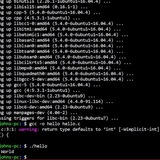
exitcode from a pipe inside an if statement
Backstory, SomeCommand produces 15-20 lines of output that the user needs to read. Sometimes it fails, most of the time in a known way.
My approach has been
if [[ `SomeCommand |tee /dev/stderr |grep -c Known Error; Xcode=${PIPESTATUS[0\]}` -gt 0 \]\]; then
echo Known error $Xcode
else
echo Unknown error $Xcode
exit
fi
/dev/stderr goes to the console so the user can see the output
grep finds the known error string & handles it correctly
but...
$Xcode is always 0 :(
If $Xcode is >0 and it's not the known error, the script should terminate.
Have been using true, false & echo as SomeCommand for testing, maybe this is an issue.
It's not the |tee part
if [[ `false |grep -c Known Error; Xcode=${PIPESTATUS[0\]}` -gt 0 \]\]; then echo found $Xcode; else echo not found $Xcode; fi
not found 0
It's something to do with the if [[ `...` \]\] bit
false |tee /dev/stderr |grep -c Known Error; Xcode=${PIPESTATUS[0\]}; echo $Xcode
0
1
If it's changed to if [...\], then it's always 1
if [ `echo "Known Error" |tee /dev/stderr |grep -c "Known Error"; Xcode=${PIPESTATUS[0\]}` -gt 0 \]; then echo found $Xcode; else echo not found $Xcode; fi
Known Error
found 1
if [ `echo "Unknown Error" |tee /dev/stderr |grep -c "Known Error"; Xcode=${PIPESTATUS[0\]}` -gt 0 \]; then echo found $Xcode; else echo not found $Xcode; fi
Unknown Error
not found 1
Someone please put me out of my misery.
https://redd.it/1j7q8as
@r_bash
In theory, could all quoting be achieved with just the backlash character? Or are there instances where single quotes are required
In other words, are single quotes supported by necessity or pure convenience?
https://redd.it/1j7jak3
@r_bash
New to grep - why are these commands returning different results?
I'm working through the Sander van Vugt RHCSA video course, and on one of the labs you're asked to "use grep to show the names of all the files in /etc that have lines that contain the text 'root' as a word."
The solution he suggest is to change your directory to /etc, and run grep 'root\\b' * 2> /dev/null which returns something like this:
https://preview.redd.it/8v6irsjkq8ge1.png?width=834&format=png&auto=webp&s=2fc253b31c6eafb2a9b53351a5150bd084763a4b
However, if I run grep 'root\\b' *2 /etc 2> /dev/null from my home directory, I get this:
https://preview.redd.it/ahneo97fr8ge1.png?width=522&format=png&auto=webp&s=a58b0001a3d8d6a3e094bd3f14ae28817c42d6bb
If I remove the 2> /dev/null to see my STDERR, I see these errors:
https://preview.redd.it/da5nd9dtq8ge1.png?width=358&format=png&auto=webp&s=3088ab8cc2515c994b7f035dba125899874dc87d
And I'm not clear on why that's the case. In the other examples he's provided, we use grep to search files in other directories. I'm sure I'm missing a flag somewhere.
I had looked into using --directories=recurse which does return results, but they different than what I see if I run grep 'root\\b' * 2> /dev/null directory from /etc:
https://preview.redd.it/pb4dz2m5s8ge1.png?width=848&format=png&auto=webp&s=1f9df5f5b743dfe188a11d43c65dc2ad236d7f60
I know I'm misunderstanding something, but I'm not sure what and I don't know if I understand grep well enough to ask the right question. In the end, what I'd like to know is if I can use grep to look into a different directory from my home directory, and what I need to be doing differently if that is an option.
https://redd.it/1ie4t0x
@r_bash
jq throwing parse errors
I have the following in a file called test.txt:
```
[
[
"a",
"b"
],
[
"c",
"d"
]
]
```
I inserted it into a shell variable like this:
```
$ test_records=$(cat test.txt)
```
When I echo test_records, I get this:
```
$ echo $test_records
[ [ "a", "b" ], [ "c", "d" ] ]
```
When I iterate through, I get the following:
```
$ for record in $test_records; do echo $record; done
[
[
"a",
"b"
],
[
"c",
"d"
]
]
```
Note the opening and closing brackets which I think are related to the issue. Anyway, when I try to pipe the result of the echo to jq, I get the following:
```
$ for record in $test_records; do echo $record | jq '.[0]'; done
jq: parse error: Unfinished JSON term at EOF at line 2, column 0
jq: parse error: Unfinished JSON term at EOF at line 2, column 0
jq: error (at <stdin>:1): Cannot index string with number
jq: parse error: Expected value before ',' at line 1, column 4
jq: error (at <stdin>:1): Cannot index string with number
jq: parse error: Unmatched ']' at line 1, column 1
jq: parse error: Unfinished JSON term at EOF at line 2, column 0
jq: error (at <stdin>:1): Cannot index string with number
jq: parse error: Expected value before ',' at line 1, column 4
jq: error (at <stdin>:1): Cannot index string with number
jq: parse error: Unmatched ']' at line 1, column 1
jq: parse error: Unmatched ']' at line 1, column 1
```
As I said, I think this is because of the opening and closing brackets. If so, why are they there? If not, what's the issue with the filter string?
Thanks,
Rob
https://redd.it/1idrbfy
@r_bash
FuzPad 1.0 is now released
https://github.com/JianZcar/FuzPad
https://redd.it/1icjoal
@r_bash
Help me improve my MySQL backup script
So I've got a working backup script for backing up MySQL databases on different database servers. The script is run every hour via cron job on an Apache server and subseqently backed up via FTP to a local NAS. I know it's not pretty, but as long as it works...
'''
#!/bin/bash
backup_dir=/backup
timestamp=$(date +%Y-%m-%dT%H:%M)
user=dbuser
backup_retention_time=10
mkdir -p "$backup_dir/$timestamp"
mysqldump --defaults-file=/files/.my.cnf --opt --no-tablespaces --user=$user --host='dbserver1.com' database_1 | gzip -9 > ${backup_dir}/$timestamp/database_1-$timestamp.sql.gz
mysqldump --defaults-file=/files/.my.cnf --opt --no-tablespaces --user=$user --host='dbserver2.com' database_2 | gzip -9 > ${backup_dir}/$timestamp/database_2-$timestamp.sql.gz
mysqldump --defaults-file=/files/.my.cnf --opt --no-tablespaces --user=$user --host='dbserver1.com' database_3 | gzip -9 > ${backup_dir}/$timestamp/database_3-$timestamp.sql.gz
mysqldump --defaults-file=/files/.my.cnf --opt --no-tablespaces --user=$user --host='dbserver3.com' database_4 | gzip -9 > ${backup_dir}/$timestamp/database_4-$timestamp.sql.gz
mysqldump --defaults-file=/files/.my.cnf --opt --no-tablespaces --user=$user --host='dbserver1.com' database_5 | gzip -9 > ${backup_dir}/$timestamp/database_5-$timestamp.sql.gz
mysqldump --defaults-file=/files/.my.cnf --opt --no-tablespaces --user=$user --host='dbserver1.com' database_6 | gzip -9 > ${backup_dir}/$timestamp/database_6-$timestamp.sql.gz
mysqldump --defaults-file=/files/.my.cnf --opt --no-tablespaces --user=$user --host='dbserver1.com' database_7 | gzip -9 > ${backup_dir}/$timestamp/database_7-$timestamp.sql.gz
mysqldump --defaults-file=/files/.my.cnf --opt --no-tablespaces --user=$user --host='dbserver1.com' database_8 | gzip -9 > ${backup_dir}/$timestamp/database_8-$timestamp.sql.gz
mysqldump --defaults-file=/files/.my.cnf --opt --no-tablespaces --user=$user --host='dbserver1.com' database_9 | gzip -9 > ${backup_dir}/$timestamp/database_9-$timestamp.sql.gz
mysqldump --defaults-file=/files/.my.cnf --opt --no-tablespaces --user=$user --host='dbserver1.com' database_10 | gzip -9 > ${backup_dir}/$timestamp/database_10-$timestamp.sql.gz
mysqldump --defaults-file=/files/.my.cnf --opt --no-tablespaces --user=$user --host='dbserver1.com' database_11 | gzip -9 > ${backup_dir}/$timestamp/database_11-$timestamp.sql.gz
mysqldump --defaults-file=/files/.my.cnf --opt --no-tablespaces --user=$user --host='dbserver1.com' database_12 | gzip -9 > ${backup_dir}/$timestamp/database_12-$timestamp.sql.gz
mysqldump --defaults-file=/files/.my.cnf --opt --no-tablespaces --user=$user --host='dbserver1.com' database_13 | gzip -9 > ${backup_dir}/$timestamp/database_13-$timestamp.sql.gz
mysqldump --defaults-file=/files/.my.cnf --opt --no-tablespaces --user=$user --host='dbserver1.com' database_14 | gzip -9 > ${backup_dir}/$timestamp/database_14-$timestamp.sql.gz
mysqldump --defaults-file=/files/.my.cnf --opt --no-tablespaces --user=$user --host='dbserver1.com' database_15 | gzip -9 > ${backup_dir}/$timestamp/database_15-$timestamp.sql.gz
mysqldump --defaults-file=/files/.my.cnf --opt --no-tablespaces --user=$user --host='dbserver4.com' database_16 | gzip -9 > ${backup_dir}/$timestamp/database_16-$timestamp.sql.gz
mysqldump --defaults-file=/files/.my.cnf --opt --no-tablespaces --user=$user --host='dbserver1.com' database_17 | gzip -9 > ${backup_dir}/$timestamp/database_17-$timestamp.sql.gz
mysqldump --defaults-file=/files/.my.cnf --opt --no-tablespaces --user=$user --host='dbserver1.com' database_18 | gzip -9 > ${backup_dir}/$timestamp/database_18-$timestamp.sql.gz
mysqldump --defaults-file=/files/.my.cnf --opt --no-tablespaces --user=$user --host='dbserver1.com' database_19 | gzip -9 > ${backup_dir}/$timestamp/database_19-$timestamp.sql.gz
mysqldump --defaults-file=/files/.my.cnf --opt --no-tablespaces --user=$user --host='dbserver2.com' database_20 | gzip -9 >
Does anyone have any good recommendations for learning awk? I've tried a few books and YT videos but I'm finding my eyes glazing over. I worked with LLMs to make it do some advanced editing and I'm super excited to learn how to actually drive it myself, but I haven't found anything that gels with me
https://redd.it/1id47fq
@r_bash
Get stderr and stdout separated?
How would I populate e with the stderr stream?r="0"; e=""; m="$(eval "$logic")" || r="1" && returnCode="1"
I need to "return" it with the function, hence I cannot use a function substitution forward of 2> >()
I just want to avoid writing to a temp file for this.
https://redd.it/1iclsku
@r_bash
convert nested css to standard syntax css
Hi im new in this sub and i don't have much experience with bash in general, i was trying to create a script that allows me to convert nested css that has multi-selector in to standard css, currently i got my script working for nested css, but it seem i can't find a way to eleaborate multi selector (es. #foo, .bar).
Also tryed to ask gpt but it just added some comments and made me feel more miserable.
Can someone give me a hand?
#!/bin/bash
# Ensure the script receives correct arguments
if [ "$#" -ne 2 ]; then
echo "Usage: $0 input_file output_file"
exit 1
fi
input_file=$1
output_file=$2
# Check if the input file exists and is readable
if [ ! -f "$input_file" ]; then
echo "Error: Input file '$input_file' does not exist or is not a file."
exit 1
fi
# Create or clear the output file
>"$output_file"
# Initialize variables
current_selector=""
current_styles=""
parent_selector_stack=()
multi_selector_members=()
is_multi_selector=false
media_query=false
# Function to flush a selector and its styles
flush_selector() {
trimmed_current_styles=$(echo "$current_styles" | sed 's/^[[:space:]]*//;s/[[:space:]]*$//')
trimmed_current_selector=$(echo "$current_selector" | sed 's/^[[:space:]]*//;s/[[:space:]]*$//')
check_style=$(echo "$current_styles" | tr -d '[:space:]\\n')
# Only flush if the selector and styles are not empty
if [ -n "$trimmed_current_selector" ] && [ -n "$check_style" ]; then
{
echo "$trimmed_current_selector {"
echo -e "$trimmed_current_styles"
echo "}"
} >>"$output_file"
fi
current_styles=""
}
# Handle multi-selectors (combine selectors with commas and ensure proper space)
handle_multi_selectors_with_children() {
local base_selectors=("$@")
local child_selector="$current_selector"
local combined_selectors=""
# Loop through each base selector and append the child selector
for base_selector in "${base_selectors[@]}"; do
if [ -n "$child_selector" ]; then
combined_selectors+="$base_selector $child_selector, "
else
combined_selectors+="$base_selector, "
fi
done
# Remove trailing comma and space
combined_selectors=$(echo "$combined_selectors" | sed 's/, $//')
echo "$combined_selectors"
}
# Read the input file line by line
while IFS= read -r line || [ -n "$line" ]; do
# Remove leading and trailing whitespace
line=$(echo "$line" | sed 's/^[[:space:]]*//;s/[[:space:]]*$//')
if [[ "$line" =~ ^@media ]]; then
# If it's a media query, start a new media query block
flush_selector
media_query=true
current_selector=$(echo "$line" | sed 's/{//g')
parent_selector_stack=("$current_selector")
continue
elif [[ "$line" =~ ^[.#\[][^,{]*\{$ ]]; then
# Handle new selector block or nested multi-selector
if [ "$is_multi_selector" = true ]; then
# If multi-selector handling was active, expand them with the current child selector
expanded_selectors=$(handle_multi_selectors_with_children "${multi_selector_members[@]}")
current_selector="$expanded_selectors"
flush_selector
multi_selector_members=() # Clear the multi-selector list
is_multi_selector=false
fi
# Flush the previous selector before processing the new one
flush_selector
# Extract the current selector and add it to the multi-selector array if needed
new_selector=$(echo "$line" | sed 's/{//g' | tr -d '\n')
if [ "$is_multi_selector" = true ]; then
YAML manipulating with basic tools, without yq
The problem. I have a YAML file with this:
network:
version: 2
renderer: networkd
ethernets:
wifis:
wlx44334c47dec3:
dhcp4: true
dhcp6: true
As you can see, there is an empty section ethernets, but we could also have wifis section empty. This is invalid structure and I need to remove those empty sections:
This result:
network:
version: 2
renderer: networkd
wifis:
wlx44334c47dec3:
dhcp4: true
dhcp6: true
can be achieved easily with:
yq -y 'del(.network.ethernets | select(length == 0)) | del(.network.wifis | select(length == 0))'
But I want to achieve the same with sed / awk / regex. Any idea how?
https://redd.it/1ib15ky
@r_bash
Simple script to integrate chat-gpt into bash
Will try this post again now...
I love messing around and modifying bash, my latest project has been to integrate chat-gpt into the command line. wanted to just type a normal command and have it reply whenever i needed/wanted it too. It became a little more complicated as i went on and had to add various functions such as save session memory for it to be effective-also added a simple menu. Works ok on my system but just after a little feedback please **you will need your own openai API key**
https://github.com/Fenlanddavid/arch-ai
Ps- did attach image but does not seem to be displaying.....
https://redd.it/1iap1xd
@r_bash
HELP!
I'm trying to make a simple OS that uses BASH and coreutils as a base.
I searched and asked to chatgpt how to compile it to a unknown os and basically everything went wrong.
btw, i'm on windows 11 with nasm,gcc, mingw, msys2 and Arch WSL.
Can someone help me?
https://redd.it/1i9qukp
@r_bash
Creating a simple latex launcher
Hello!
I'm not sure I'm posting in the good subreddit, don't hesitate to redirect me!
I've a little problem I'm not able to solve, because I don't understand well enough the problem to know where to search.
I would like to create a script that manages a .tex file such as :
- it opens a terminal and launches latex -pdf -pvc $FILE, $FILE being the argument file
- it opens the file with kwrite
Ideally, I declare this script as an application that I can set as the default application for .tex files. This way, when I double click on the file every of these actions execute themselves.
I first tried to create a latex.sh script (yes it's executable) :
#!/bin/bash
latexmk -pdf -pvc $1 &
kwrite $1 &
.desktop file in ~/.local/share/applications and tried to open a .tex file with this application. Without surprise it does not work, but I don't really know what exactly is the process I want to see in the system so it's difficult to improve the script...
style enforcement tool?
Hi folks, looking for a sh and bash enforcement tool. I found bashate but seems too limited.
https://redd.it/1i5yexv
@r_bash
rmdir "No such file or directory" but ls shows folder isn't empty
I am trying to clean up some old media files.
When I use ls to show the contents of my current folder, it lists one folder. When I use rmdir to remove that folder, it states:
ls: folder: No such file or directory
How do I get rid of the target directory?
https://redd.it/1i61br6
@r_bash
> bib (a Bible reference tool for CLI)
https://redd.it/1j7qfl3
@r_bash
HELP Please. The while loop is running before SSH has ended completely.
https://preview.redd.it/6yv2drjx0ine1.png?width=687&format=png&auto=webp&s=afaef25c281cf083cbc5685e7552203ef6375e58
https://preview.redd.it/f622kvze1ine1.png?width=596&format=png&auto=webp&s=943b60670c3d4ce0e63d5e143673302c5db97f08
So I wrote this code to automate ssh and storing passwords in OverTheWire challenge.
Problem : When I press Enter nothing happens.
What I think the problem is : The while loop starts running before the SSH ends completely. Even GPT did not help.
Can someone please tell me wat the issue is, and how to fix it?
https://redd.it/1j6lxab
@r_bash
Can I get a variable, at all times, to keep the output of the last command?
To capture the output of a command, I do
2>&1|tee capture.log
, but this is tedious and I find myself always needing it.
Is it possible to do some magic in the background, so that the output of the last command is always captured in an environment variable?
I don't want to prefix the command with something like "capture" and I don't want to suffix it, with "2>&1";)
I just want the variable, at all times, to keep the output of the last command.
https://redd.it/1ie270l
@r_bash
How to configure terminal to show the entire previous command, without truncating it with an ellipsis?
Using iterm2 on MacOS with ZSH and powerlevel10k and Oh-My-Zsh. Nothing unusual.
When I paste a long `curl` command (with a request body that has a few dozen lines or more) into the terminal and execute it, I want to see the entire command when I press the Up arrow key to reload the last command from my history.
But what actually happens is only the last 30 or so lines of the command are shown when I press the Up arrow key, truncating all the lines above with an ellipsis (...).
I want to configure my terminal to actually display the *whole* entire command when I press Up.
I assume this is a config issue somewhere either in my `\~/.zshrc` file or the `\~/.p10k.zsh` file, but have no clue if that's correct.
https://redd.it/1ic5jhd
@r_bash
${backup_dir}/$timestamp/database_20-$timestamp.sql.gz
mysqldump --defaults-file=/files/.my.cnf --opt --no-tablespaces --user=$user --host='dbserver1.com' database_21 | gzip -9 > ${backup_dir}/$timestamp/database_21-$timestamp.sql.gz
mysqldump --defaults-file=/files/.my.cnf --opt --no-tablespaces --user=$user --host='dbserver1.com' database_22 | gzip -9 > ${backup_dir}/$timestamp/database_22-$timestamp.sql.gz
mysqldump --defaults-file=/files/.my.cnf --opt --no-tablespaces --user=$user --host='dbserver1.com' database_23 | gzip -9 > ${backup_dir}/$timestamp/database_23-$timestamp.sql.gz
mysqldump --defaults-file=/files/.my.cnf --opt --no-tablespaces --user=$user --host='dbserver1.com' database_24 | gzip -9 > ${backup_dir}/$timestamp/database_24-$timestamp.sql.gz
mysqldump --defaults-file=/files/.my.cnf --opt --no-tablespaces --user=$user --host='dbserver1.com' database_25 | gzip -9 > ${backup_dir}/$timestamp/database_25-$timestamp.sql.gz
find $backup_dir -depth -type d -mtime +$backup_retention_time -exec rm -r {} \;
'''
My main goal is to implement a rolling backup/retention strategy, i.e. I want to keep
* 24 hourly backups
* 7 daily backups
* 12 monthly backups
Any help is greatly appreciated!
EDIT: changed the timestamp from %Y-%m-%dT%H:%M to %Y-%m-%dT%H-%M for better compatibility.
https://redd.it/1icu3vc
@r_bash
Help me improve my MySQL backup script
So I've got a working backup script for backing up MySQL databases on different database servers. The script is run every hour via cron job on an Apache server and subseqently backed up via FTP to a local NAS. I know it's not pretty, but as long as it works...
'''
#!/bin/bash
backupdir=/backup
timestamp=$(date +%Y-%m-%dT%H:%M)
user=dbuser
backupretentiontime=10
mkdir -p "$backupdir/$timestamp"
mysqldump --defaults-file=/files/.my.cnf --opt --no-tablespaces --user=$user --host='dbserver1.com' database1 | gzip -9 > ${backupdir}/$timestamp/database1-$timestamp.sql.gz
mysqldump --defaults-file=/files/.my.cnf --opt --no-tablespaces --user=$user --host='dbserver2.com' database2 | gzip -9 > ${backupdir}/$timestamp/database2-$timestamp.sql.gz
mysqldump --defaults-file=/files/.my.cnf --opt --no-tablespaces --user=$user --host='dbserver1.com' database3 | gzip -9 > ${backupdir}/$timestamp/database3-$timestamp.sql.gz
mysqldump --defaults-file=/files/.my.cnf --opt --no-tablespaces --user=$user --host='dbserver3.com' database4 | gzip -9 > ${backupdir}/$timestamp/database4-$timestamp.sql.gz
mysqldump --defaults-file=/files/.my.cnf --opt --no-tablespaces --user=$user --host='dbserver1.com' database5 | gzip -9 > ${backupdir}/$timestamp/database5-$timestamp.sql.gz
mysqldump --defaults-file=/files/.my.cnf --opt --no-tablespaces --user=$user --host='dbserver1.com' database6 | gzip -9 > ${backupdir}/$timestamp/database6-$timestamp.sql.gz
mysqldump --defaults-file=/files/.my.cnf --opt --no-tablespaces --user=$user --host='dbserver1.com' database7 | gzip -9 > ${backupdir}/$timestamp/database7-$timestamp.sql.gz
mysqldump --defaults-file=/files/.my.cnf --opt --no-tablespaces --user=$user --host='dbserver1.com' database8 | gzip -9 > ${backupdir}/$timestamp/database8-$timestamp.sql.gz
mysqldump --defaults-file=/files/.my.cnf --opt --no-tablespaces --user=$user --host='dbserver1.com' database9 | gzip -9 > ${backupdir}/$timestamp/database9-$timestamp.sql.gz
mysqldump --defaults-file=/files/.my.cnf --opt --no-tablespaces --user=$user --host='dbserver1.com' database10 | gzip -9 > ${backupdir}/$timestamp/database10-$timestamp.sql.gz
mysqldump --defaults-file=/files/.my.cnf --opt --no-tablespaces --user=$user --host='dbserver1.com' database11 | gzip -9 > ${backupdir}/$timestamp/database11-$timestamp.sql.gz
mysqldump --defaults-file=/files/.my.cnf --opt --no-tablespaces --user=$user --host='dbserver1.com' database12 | gzip -9 > ${backupdir}/$timestamp/database12-$timestamp.sql.gz
mysqldump --defaults-file=/files/.my.cnf --opt --no-tablespaces --user=$user --host='dbserver1.com' database13 | gzip -9 > ${backupdir}/$timestamp/database13-$timestamp.sql.gz
mysqldump --defaults-file=/files/.my.cnf --opt --no-tablespaces --user=$user --host='dbserver1.com' database14 | gzip -9 > ${backupdir}/$timestamp/database14-$timestamp.sql.gz
mysqldump --defaults-file=/files/.my.cnf --opt --no-tablespaces --user=$user --host='dbserver1.com' database15 | gzip -9 > ${backupdir}/$timestamp/database15-$timestamp.sql.gz
mysqldump --defaults-file=/files/.my.cnf --opt --no-tablespaces --user=$user --host='dbserver4.com' database16 | gzip -9 > ${backupdir}/$timestamp/database16-$timestamp.sql.gz
mysqldump --defaults-file=/files/.my.cnf --opt --no-tablespaces --user=$user --host='dbserver1.com' database17 | gzip -9 > ${backupdir}/$timestamp/database17-$timestamp.sql.gz
mysqldump --defaults-file=/files/.my.cnf --opt --no-tablespaces --user=$user --host='dbserver1.com' database18 | gzip -9 > ${backupdir}/$timestamp/database18-$timestamp.sql.gz
mysqldump --defaults-file=/files/.my.cnf --opt --no-tablespaces --user=$user --host='dbserver1.com' database19 | gzip -9 > ${backupdir}/$timestamp/database19-$timestamp.sql.gz
mysqldump --defaults-file=/files/.my.cnf --opt --no-tablespaces --user=$user --host='dbserver2.com' database20 | gzip -9 >
Why is "set -e" not the default or not left in scripts after creation?
"set -e" as most of you know will exit a script on error. It (and other set commands) is often used in a script during development when errors are expected and you want immediate halt.
But why is this behavior not the default anyway? Surely in vast majority of cases when a script is in production and there is an error, you would want the script to halt rather than attempt to execute the rest of it (much of which will have dependency and less likely to just be an independent process)?
https://redd.it/1icwuqh
@r_bash
multi_selector_members+=("$new_selector")
parent_selector_stack+=("&referencetomultiselect&")
else
# If there's a current selector, combine it with the new selector
if [ -n "$current_selector" ]; then
current_selector="$current_selector $new_selector"
else
current_selector="$new_selector"
fi
parent_selector_stack+=("$current_selector")
fi
elif [[ "$line" =~ ^[.#\[][^,{]*,$ ]]; then
# Handle multi-selectors (those ending with a comma)
is_multi_selector=true
new_selector=$(echo "$line" | sed 's/,//g' | tr -d '\n')
multi_selector_members+=("$new_selector")
elif [[ "$line" =~ ^\}$ ]]; then
# End of the current block
flush_selector
# Handle multi-selector members if they exist
if [ "$is_multi_selector" = true ]; then
expanded_selectors=$(handle_multi_selectors_with_children "${multi_selector_members[@]}")
current_selector="$expanded_selectors"
flush_selector
multi_selector_members=() # Clear the multi-selector list
is_multi_selector=false
fi
# Reset media query flag if we're closing a media query
if [ "$media_query" = true ]; then
media_query=false
fi
# Loop through parent_selector_stack and find references to multi-selector
final_selectors=()
for selector in "${parent_selector_stack[@]}"; do
if [[ "$selector" == "&referencetomultiselect&" ]]; then
# Replace reference with expanded multi-selectors
final_selectors+=($(handle_multi_selectors_with_children "${multi_selector_members[@]}"))
else
final_selectors+=("$selector")
fi
done
# Add the final selectors back to the parent stack
parent_selector_stack=("${final_selectors[@]}")
# Pop the last selector from the stack (we're closing the current block)
if [ ${#parent_selector_stack[@]} -gt 0 ]; then
unset 'parent_selector_stack[-1]'
fi
# Reset the current selector to the top of the stack
if [ ${#parent_selector_stack[@]} -gt 0 ]; then
current_selector="${parent_selector_stack[-1]}"
else
current_selector=""
fi
else
# Treat the line as a style and append it
current_styles="$current_styles\n $line"
fi
done <"$input_file"
# Flush any remaining selectors
flush_selector
echo "CSS processing complete. Output written to $output_file"
https://redd.it/1ic6azt
@r_bash
want to print only the real timetime ./prog
real 0m0.004s
user 0m0.001s
sys 0m0.003s
but i only want to print the first linereal 0m0.004s or 0m0.004s
is there any way ?```
https://redd.it/1ib76ah
@r_bash
Shunpo: A Bash Tool for Quick Directory Navigation
Hi fellow redditors. I recently wrote a minimalistic navigation tool for bash. A few of my colleagues liked it, so I thought I'd make the repository public and share it. Here's a video demo-ing it . I hope it helps speed up your navigation!
Link to the repo:
https://github.com/egurapha/Shunpo
Link to a youtube video:
https://www.youtube.com/watch?v=TN66A3MPo50
https://i.redd.it/o2t12nrceefe1.gif
https://redd.it/1iap8nv
@r_bash
Chatgpt in bash
Hi, first post here so please go easy..... !
I love modifying bash, and have recently thought about having Chatgpt work directly from bash by just typing a simple command whenever needed/wanted. As a result i have created the following, it seems to work fine and have added a menu to it for added functionality.
Feedback would be most welcome please - https://github.com/Fenlanddavid/AI-command/blob/main/gpt.sh
https://redd.it/1ial3l3
@r_bash
Importance of checking IFS
I just wanted to spread a word about importance of explicitly defining and assigning values to IFS.
After years of scripting in bash in Ubuntu i never thought of non standard IFS values in other linux based operating systems.
Few minutes ago figured out why some of my scripts weren’t working properly in openwrt. IFS in openwrt contains only /n newline character vs tab space and newline.
Can be checked by looking into environment via set (printenv is not installed by default) or simply by echoing IFS and piping into cat: echo “$IFS” | cat -A
Hope this will save someone down the road from wasting hours on debugging.
My scripts weren’t working simply copied to openwrt as they were working on Ubuntu and didnt show any issues at first glance. I want to pinpoint here that i didnt write in openwrt environment or else i would have checked IFS. From now on i will make a habit to assign it right after the shebang.
Thanks.
https://redd.it/1i9qz8r
@r_bash
Sed replacement with a variable needs single and double quotes
Hi all, this may be a stupid question, so sorry in advance. I have just started to get into the world of bash scripting, and I decided to create an install script for my NixOS build. Within that, I want to create a new host, so I have decided to use sed to add a block of Nix code from a text file in place of a comment that I have there by default. The problem arises then that I need to evaluate bash script within it using double quotes "" as well as using the s option at the start, which from what I can see only works with single quotes ''.
From what I could find when googling this, I need to exit the single quotes with double quotes when writing the expression, then go back to singles to finish it.
https://askubuntu.com/questions/1390037/using-sed-with-a-variable-inside-double-quote
So this is what i have so far sudo sed -i 's|#Install new host hook|'"$(< /etc/nixos/scripts/helperFiles/newHostFlakeBlock.txt)"'|' /etc/nixos/flake.nix
https://redd.it/1i8te4k
@r_bash
Error oh my bash theme development
Good evening everyone, I'm making another theme for Oh My Bash that has the same base as my old theme, but it's not overwriting the base properly, these are the codes
New theme
if [ -z "${NEKONIGHT_BASE_LOADED}" ]; then
  source ~/.oh-my-bash/themes/nekonight/nekonight-base.sh
  export NEKONIGHT_BASE_LOADED=true
fi


icon_start="╭─"
icon_user=" 🌙 ${_omb_prompt_bold_olive}\u${_omb_prompt_normal}"
icon_host=" at 🌙 ${_omb_prompt_bold_cyan}\h${_omb_prompt_normal}"
icon_directory=" in 🌙 ${_omb_prompt_bold_magenta}\w${_omb_prompt_normal}"
icon_end="╰─${_omb_prompt_bold_white}λ${_omb_prompt_normal}"

_omb_theme_nekonight_git_prompt_info
_omb_theme_nekonight_scm_git_status

function _omb_theme_PROMPT_COMMAND() {
  PS1="${icon_start}${icon_user}${icon_host}${icon_directory} in $(_omb_theme_nekonight_git_prompt_info)\n${icon_end} "
}

_omb_util_add_prompt_command _omb_theme_PROMPT_COMMAND
 shell
icon_start="╭─"
icon_user=" 🐱 ${_omb_prompt_bold_olive}\u${_omb_prompt_normal}"
icon_host=" at 🐱 ${_omb_prompt_bold_cyan}\h${_omb_prompt_normal}"
icon_directory=" in 🐱 ${_omb_prompt_bold_magenta}\w${_omb_prompt_normal}"
icon_end="╰─${_omb_prompt_bold_white}λ${_omb_prompt_normal}"

function _omb_theme_nekonight_git_prompt_info() {
  local branch_name
  branch_name=$(git symbolic-ref --short HEAD 2>/dev/null)
  local git_status=""

  if [[ -n $branch_name ]]; then
    git_status="${_omb_prompt_bold_white}(🐱 $branch_name $(_omb_theme_nekonight_scm_git_status))${_omb_prompt_normal}"
  fi

  echo -n "$git_status"
}

function _omb_theme_nekonight_scm_git_status() {
  local git_status=""

  if git rev-list --count --left-right @{upstream}...HEAD 2>/dev/null | grep -Eq '^[0-9]+\s[0-9]+$'; then
    git_status+="${_omb_prompt_brown}↓${_omb_prompt_normal} "
  fi

  if [[ -n $(git diff --cached --name-status 2>/dev/null) ]]; then
    git_status+="${_omb_prompt_green}+${_omb_prompt_normal}"
  fi

  if [[ -n $(git diff --name-status 2>/dev/null) ]]; then
    git_status+="${_omb_prompt_yellow}•${_omb_prompt_normal}"
  fi

  if [[ -n $(git ls-files --others --exclude-standard 2>/dev/null) ]]; then
    git_status+="${_omb_prompt_red}⌀${_omb_prompt_normal}"
  fi

  echo -n "$git_status"
}
\\\[\\e\[97;1m\\\](🐱 main \\\[\\e\[0;31m\\\]↓\\\[\\e\[0m\\\] \\\[\\e\[0;93m\\\]•\\\[\\e\[0m\\\]\\\[\\e\[0;91m\\\]⌀\\\[\\e\[0m\\\])\\\[\\e\[0m\\\]\\\[\\e\[0;31m\\\]↓\\\[\\e\[0m\\\] \\\[\\e\[0;93m\\\]•\\\[\\e\[0m\\\]\\\[\\e\[0m\\\]╭─ 🌙 brunociccarino at 🌙 DESKTOP-27DNBRN in 🌙 \~ in (🐱 main ↓ •⌀)

╰─λ
I made a simple "UI Library" for bash called basil. And a small helper for sourcing the library and creating a ready to run file.
Black and white mode
normal mode
retro mode
BASIL
https://redd.it/1i5sn8w
@r_bash


