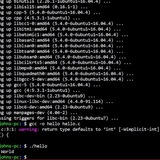
Quotes hell
E.g.:whoami arch-chroot /mnt bash -c "echo -en a bc'\'nde f>/home/a/Downloads/a.txt sed '1s/a // \$s/b c//' /home/a/Downloads/b.txt" ls /home|tee .txt
the issue: I want all|tee .txt (from whoami to ls /home, not only the latter), but ' & " are already used, so how to?
Maybe using parentheses or some binary characters, instead of quotes?
Maybe the answer is in man bash but TLDR...
https://redd.it/1rsc90a
@r_bash
I'm making this tool for a long time
https://redd.it/1t5mwfw
@r_bash
I wrote a stupid simple progress bar in pure BASH (source in comments)
https://redd.it/1sui2g5
@r_bash
Asking the human experts here, how would you turn something like this into a production grade script?
#!/usr/bin/env bash

function handle_exit() {
 local -r exit_code="$1"

 printf "%s\n" "exit_code:${exit_code}"
}

function run_brotli_decompress() {
 local -r input_path="$1"
 local -r output_path="$2"

 brotli \
  --decompress \
  --output="${output_path}" \
  --rm \
  "${input_path}"
}

function run_tar_decompress() {
 local -r input_path="$1"
 local -r output_path="$2"

 local -r directory=$(dirname "${input_path}")

 tar \
  --directory="${directory}" \
  --extract \
  --file "${input_path}"
}

function run_pg_restore() {
 local -r dbname="$1"
 local -r host="$2"
 local -r port="$3"
 local -r username="$4"

 local -r jobs="$5"

 local -r file="$6"

 pg_restore \
  --dbname="${dbname}" \
  --disable-triggers \
  --exit-on-error \
  --format=directory \
  --host="${host}" \
  --jobs="${jobs}" \
  --no-acl \
  --no-owner \
  --no-password \
  --no-privileges \
  --port="${port}" \
  --username="${username}" \
  "${file}"
}

function main() {
 trap 'handle_exit $?' EXIT

 run_brotli_decompress \
  "/tmp/test_db.tar.gz.br" \
  "/tmp/test_db.tar.gz" || return 1

 run_tar_decompress \
  "/tmp/test_db.tar.gz" \
  "/tmp/test_db" || return 1

 run_pg_restore \
  "test_db" \
  "localhost" \
  "5432" \
  "test_user" \
  8 \
  "/tmp/test_db" || return 1
}

main "$@"
Is the order of the flags important in all commands in bash?
```
function test() {
local -n args="$1"
printf "%s\n" "running items now"
local -a pg_restore_flags=(
"--disable-triggers"
"--exit-on-error"
"--format=directory"
"--no-acl"
"--no-owner"
"--no-password"
"--no-privileges"
)
local key
for key in "${!args[@]}"; do
local value
value="${args[${key}]}"
pg_restore_flags+=("--${key}=${value}")
done
printf "%s\n" "${pg_restore_flags[*]}"
# pg_restore "${pg_restore_flags[*]}" is that a bad idea?
}
function main() {
trap 'handle_exit $?' EXIT
local -A items=(["dbname"]="test_db" ["host"]="localhost" ["jobs"]=8 ["port"]=5432 ["username"]="test_user")
test items
}
main "$@"
```
- There are often commands that I would like to pack into a function where I can check multiple things like: does the command exist? are all arguments valid? Redirect error to stderr etc.
- Take this pg_restore function for example. It takes so many arguments that I was thinking why not send an associative array instead but it seems order is not preserved when using associative arrays
- Is this going to be a problem say if I started wrapping commands like this inside a function that accepts an associative array with required flags?
https://redd.it/1st8ikv
@r_bash
Bash Ships
I've gone and written another terminal game, this time a version of the old strategy game Battleships. I'm just sharing here really, but - I hope some might at least find the mouse control / cursor positioning of interest or useful. With a bit of effort you can write some quite slick and ergonomic applications in Bash.
EDIT: suppose I should include the URL: https://github.com/StarShovel/bash-ships
https://preview.redd.it/3lerw7nmfswg1.jpg?width=683&format=pjpg&auto=webp&s=97ef05b2eaa3a10f8a92659a7ca36b7073b276c6
https://preview.redd.it/gh1lkgbqfswg1.png?width=800&format=png&auto=webp&s=bcb6fcdfd9e39db6c0da7a06ed9cd59e2e4af0e6
https://redd.it/1ssujli
@r_bash
How to launch a program in bash.
hello I'm looking to launch a C program in bash, I launch the usual program as its 'sudo./p' so if I see a stcript bash that launches in my place what will it give? I tried its #!/bin/bash sudo./p
https://redd.it/1ss1p31
@r_bash
What is the difference between have 2 separate ERR and EXIT traps vs a single EXIT trap for handling everything?
I have a function called testcommand that looks like this
```
function testcommand() {
local -r command="$1"
if eval "${command}"; then
printf "%s\n" "INFO: the command completed its execution successfully"
return 0
else
printf "%s\n" "ERROR: the command failed to execute"
return 1
fi
}
In this invocation, I am calling a main() function that calls this command with a single trap
#!/usr/bin/env bash

ERROR_LOG_FILE=$(mktemp)

function handle_exit() {
 local error_message
 local -r exit_code="$1"

 error_message="$(cat "${ERROR_LOG_FILE}")"

 if [[ -z "${error_message}" ]]; then

  printf "handle_exit: INFO: date:%s, exit_code::%s, error:%s\n" "$(date)" "${exit_code}" "No errors were detected"
 else
  printf "handle_exit: ERROR: date:%s, exit_code::%s, error:%s\n" "$(date)" "${exit_code}" "${error_message}"

 fi

 if [[ -f "${ERROR_LOG_FILE}" ]]; then
  rm -f "${ERROR_LOG_FILE}"
 fi
}
function main() {
 trap 'handle_error' ERR
 trap 'handle_exit $?' EXIT

 local command="$1"

 case "${command}" in
 "ls") ;;
 *)
  command="bad_command"
  ;;
 esac

 printf "%s\n" "This is our error log file ${ERROR_LOG_FILE}"

 if ! test_command "${command}" 2>"${ERROR_LOG_FILE}"; then
  return 1
 fi
}

main "$@"
#!/usr/bin/env bash

ERROR_LOG_FILE=$(mktemp)

function handle_error() {
 local arg="$1"
 printf "%s\n" "handle_error called at date:$(date) ${arg}"

 if [[ -f "${ERROR_LOG_FILE}" ]]; then
  rm -f "${ERROR_LOG_FILE}"
 fi
}

function handle_exit() {
 local arg="$1"
 printf "%s\n" "handle_exit called at date:$(date) ${arg}"

 if [[ -f "${ERROR_LOG_FILE}" ]]; then
  rm -f "${ERROR_LOG_FILE}"
 fi
}
\
--env "PGPASSWORD=${password}" \
--env "POSTGRES_PORT=${port}" \
--env "POSTGRES_USER=${username}" \
--name "${container_name}" \
--publish "${port}:${port}" \
"postgres:18.1-trixie"; then
return 1
fi
}
function stop_and_remove_container() {
local container_name="$1"
if ! stop_container "${container_name}"; then
return 1
fi
if ! remove_container "${container_name}"; then
return 1
fi
}
function stop_container() {
if [[ -z "$(command -v docker)" ]]; then
log_error "The docker command was not found, check if it is installed"
return 1
fi
if [[ "$#" -lt 1 ]]; then
log_error "Usage: stop_container <container_name>"
return 1
fi
local -r container_name="$1"
shift 1
if [[ -z "${container_name}" ]]; then
log_error "No value was supplied for container_name:${container_name}"
return 1
fi
if ! docker container stop "${container_name}"; then
return 1
fi
}
function main() {
trap 'cleanup $LINENO' EXIT
local -r POSTGRES_DB="${POSTGRES_DB}"
local -r POSTGRES_HOST="${POSTGRES_HOST}"
local -r POSTGRES_PASSWORD="${POSTGRES_PASSWORD}"
local -r POSTGRES_PORT="${POSTGRES_PORT}"
local -r POSTGRES_USER="${POSTGRES_USER}"
local -r bucket_url="s3://some-bucket"
local -r container_name="pg_dumper"
local -r date_str="$(date +%d_%m_%y_%HH_%MM_%SS_%Z)"
local -r email_template_success="template-success"
local -r file_name_prefix="${POSTGRES_DB}"
local -r file_name_suffix="${date_str}"
local -r from_email="cron@xyz.com"
local -r to_email="xyz@gmail.com"
local -r dump_file_name="${file_name_prefix}_${file_name_suffix}"
local email_template_data
local rows
if ! start_container \
"${container_name}" \
"${POSTGRES_DB}" \
"${POSTGRES_HOST}" \
"${POSTGRES_PASSWORD}" \
"${POSTGRES_PORT}" \
"${POSTGRES_USER}"; then
return 1
fi
if ! install_dependencies \
"${container_name}"; then
return 1
fi
if ! copy_files_to_container \
"${script_directory}/docker_pg_dump.sh" \
"${container_name}:/root"; then
return 1
fi
if ! run_script_inside_container \
"${container_name}" \
"${dump_file_name}" \
"${POSTGRES_DB}" \
"${POSTGRES_HOST}" \
"${POSTGRES_PASSWORD}" \
"${POSTGRES_PORT}" \
"${POSTGRES_USER}"; then
return 1
fi
if ! copy_files_from_container \
"${container_name}:/tmp/${dump_file_name}.tar.gz.br" \
"/tmp"; then
return 1
fi
if ! stop_and_remove_container \
"${container_name}"; then
return 1
fi
if rows=$(fetch_table_row_counts \
"${POSTGRES_DB}" \
"${POSTGRES_HOST}" \
"${POSTGRES_PORT}" \
"${POSTGRES_USER}"); then
log_info "We got the rows: ${rows}"
else
return 1
fi
# Handle the case where nothing is returned because you ran it on an empty database with no tables
if [[ -z "${rows}" ]]; then
rows="[]"
fi
# shellcheck disable=SC2016
if email_template_data=$(prepare_template_data "tables" "${rows}" '{tables:$tables}'); then
log_info "We got the email template data: ${email_template_data}"
else
return 1
fi
if ! save_files_to_s3 \
"/tmp/${dump_file_name}.tar.gz.br" \
"${bucket_url}"; then
return 1
fi
if ! send_email \
"${from_email}" \
"${to_email}" \
"${email_template_data}" \
"${email_template_success}"; then
return 1
fi
# The backup file has been saved to S3 and we no longer need it locally
rm -f "/tmp/${dump_file_name}.tar.gz.br"
}
main "$@"
```
https://redd.it/1spjark
@r_bash
"$(command -v psql)" ]]; then
log_error "The psql command was not found, check if it is installed"
return 1
fi
if [[ "$#" -lt 4 ]]; then
log_error "Usage: fetch_table_row_counts <dbname> <host> <port> <username>"
return 1
fi
local -r dbname="$1"
local -r host="$2"
local -r port="$3"
local -r username="$4"
shift 4
if [[ -z "${dbname}" ]]; then
log_error "No value was supplied for dbname:${dbname}"
return 1
fi
if [[ -z "${host}" ]]; then
log_error "No value was supplied for host:${host}"
return 1
fi
if [[ -z "${port}" ]]; then
log_error "No value was supplied for port:${port}"
return 1
fi
if [[ -z "${username}" ]]; then
log_error "No value was supplied for username:${username}"
return 1
fi
local -r query="
SELECT
json_agg(row)
FROM
(
WITH tbl AS
(
SELECT
table_schema,
table_name
FROM
information_schema.tables
WHERE
table_name NOT LIKE 'pg_%'
AND table_schema IN
(
'public'
)
)
SELECT
table_name,
(
xpath('/row/c/text()', query_to_xml(format('select count(*) as c from %I.%I', table_schema, table_name), FALSE, TRUE, ''))
)
[1]::text::INT AS rows_n
FROM
tbl
ORDER BY
table_name ASC
) row;
"
if result=$(psql \
"--dbname=${dbname}" \
"--host=${host}" \
"--port=${port}" \
"--username=${username}" \
"--command=${query}" \
"--no-align" \
"--tuples-only"); then
printf "%s\n" "${result}"
return 0
else
return 1
fi
}
function install_dependencies() {
if [[ -z "$(command -v docker)" ]]; then
log_error "The docker command was not found, check if it is installed"
return 1
fi
if [[ "$#" -lt 1 ]]; then
log_error "Usage: install_dependencies <container_name>"
return 1
fi
local -r container_name="$1"
shift 1
if [[ -z "${container_name}" ]]; then
log_error "No value was supplied for container_name:${container_name}"
return 1
fi
local -r command="apt-get update -qq --yes && apt-get install --no-install-recommends -qq --yes brotli tar && rm -rf /var/lib/apt/lists/*"
if ! docker container exec "${container_name}" /bin/bash -c "${command}"; then
return 1
fi
}
function prepare_template_data() {
if [[ -z "$(command -v jq)" ]]; then
log_error "The jq command was not found, check if it is installed"
return 1
fi
if [[ "$#" -lt 3 ]]; then
log_error "Usage: prepare_template_data <key> <value> <template>"
return 1
fi
local -r key="$1"
local -r value="$2"
local -r template="$3"
shift 3
if [[ -z "${key}" ]]; then
log_error "No value was supplied for key:${key}"
return 1
fi
if [[ -z "${value}" ]]; then
log_error "No value was supplied for value:${value}"
return 1
fi
if [[ -z "${template}" ]]; then
log_error "No value was supplied for template:${template}"
return 1
fi
if ! jq --null-input --argjson "${key}" "${value}" "${template}"; then
return 1
fi
}
function remove_container() {
if [[ -z "$(command -v docker)" ]]; then
log_error "The docker command was not found, check if it is installed"
return 1
fi
if [[ "$#" -lt 1 ]]; then
log_error "Usage: remove_container <container_name>"
return 1
fi
local -r container_name="$1"
shift 1
if [[ -z "${container_name}" ]]; then
log_error "No value was supplied for container_name:${container_name}"
return 1
fi
if ! docker container rm "${container_name}"; then
return 1
fi
}
function run_script_inside_container() {
if [[ -z "$(command -v docker)" ]]; then
log_error "The docker command was not found, check if it is installed"
return 1
fi
if [[ "$#" -lt 7 ]]; then
log_error "Usage: run_script_inside_container <container_name> <dump_file_name> <dbname> <host> <password> <port> <username>"
return 1
fi
local -r container_name="$1"
local -r dump_file_name="$2"
local -r dbname="$3"
local -r host="$4"
local -r password="$5"
local -r port="$6"
local -r username="$7"
shift 7
if [[ -z "${container_name}" ]]; then
log_error "No value was supplied for container_name:${container_name}"
return 1
fi
if [[ -z
Unable to divide string into array
~~~
#!/bin/bash
cd /System/Applications
files=$(ls -a)
IFS=' ' read -ra fileArray <<< $files
#I=0
#while $I -le ${#fileArray[@} ]; do
#echo ${fileArrayI}
#I=$((I++))
#done
#for I in ${fileArray*}; do
#echo $I
#done
#echo $files
~~~
I wrote code to get all of the files in a directory and then put each file into an array. However, when I try to print each element in the array, it only prints the first one. What am I doing wrong?
(The comments show my previous attempts to fix the problem and/or previous code, review them as needed.)
https://redd.it/1spgrvm
@r_bash
I made a Flatpak GUI using Bash + YAD
https://redd.it/1sobuj3
@r_bash
Persistent Sidebar Pane within TMUX that tracks your AI Agent Sessions
https://redd.it/1snrhxc
@r_bash
Bash script to determine if I have a routable IP address
At my home I have a dynamic IP address which changes at least daily. I have an arrangement with my ISP to always have a routable IP. However, sometimes they mess up and give me a non-routable IP. I would like to be able to detect this from within a shell script so that the shell script can notify me and take other action.
Here's what I'm doing now: I have a remote Raspberry Pi set up with a reverse SSH tunnel to my iMac at home. I can easily detect whether that tunnel is up or not. If it is not up, then it is likely, but not 100% sure, that the cause is a non-routable IP at home. The router at home is a Deco X20.
Is there a better way to determine whether or not my home IP address is routable or not?
https://redd.it/1slznt2
@r_bash
IP Identification Open Source Intel script
This is just a quick script I created because I am constantly having to lookup the information for IP addresses and this one will give you the SOA record for the server the IP is hosted on the whois information for the domain that the IP points as well as the nameservers and a few other relative bits of information. I called it IPID but I feel like there is something similar already out there with the same name so I am not taking credit for the name.
as with any bash script you will need to add it to PATH if you want to use it as a local shell command.
hope someone finds it useful.
https://preview.redd.it/b81ewoinv6vg1.png?width=1033&format=png&auto=webp&s=fce2610c2248e6d61d630e4280714b4b721bfc2a
#!/bin/bash
# Define colors for a cleaner, readable output
GREEN='\0330;32m'
CYAN='\033[0;36m'
RED='\033[0;31m'
YELLOW='\033[1;33m'
NC='\033[0m' # No Color
# Check if an argument is provided; if not, display the usage template
if [ -z "$1" ; then
echo -e "${RED}Error: No IPv4 address supplied.${NC}"
echo -e "Usage: ${GREEN}ipid <ipv4address>${NC}"
echo -e "Example: ${GREEN}ipid 8.8.8.8${NC}"
exit 1
fi
TARGETIP=$1
# Basic IPv4 validation
if ! [ $TARGET_IP =~ ^[0-9{1,3}\.0-9{1,3}\.0-9{1,3}\.0-9{1,3}$ ]]; then
echo -e "${RED}Error: '$TARGETIP' does not look like a valid IPv4 address.${NC}"
exit 1
fi
echo -e "${YELLOW}Gathering intelligence for IP: ${TARGETIP}...${NC}\n"
# 1. Reverse DNS / Hostname
echo -e "${CYAN}+ Hostname & Reverse DNS Lookup${NC}"
if command -v host &> /dev/null; then
host "$TARGETIP"
else
echo -e "${RED}[!] 'host' command not found. Skipping reverse DNS.${NC}"
fi
echo ""
# 2. Server Location, ASN, and ISP Details (via ipinfo.io)
echo -e "${CYAN}[+] Server Location & ISP Details${NC}"
if command -v curl &> /dev/null; then
# Fetching JSON data and displaying it cleanly
curl -s "https://ipinfo.io/${TARGETIP}/json" | grep -v 'readme'
else
echo -e "${RED}! 'curl' command not found. Skipping location details.${NC}"
fi
echo ""
# 3. WHOIS Organization & Network Info
echo -e "${CYAN}+ WHOIS Organization & Domain Info (Summary)${NC}"
if command -v whois &> /dev/null; then
# Grepping the most relevant fields so the terminal isn't flooded with legalese
whois "$TARGETIP" | grep -iE '^(OrgName|Organization|NetName|NetRange|CIDR|Country|StateProv|City|RegDate|Updated|ASName)' | sort -u | head -n 15
# If the summary is empty, the whois server might use different formatting
if [ ${PIPESTATUS[0]} -ne 0 ]; then
echo "Could not parse standard WHOIS summary. Try running 'whois $TARGETIP' manually."
fi
else
echo -e "${RED}! 'whois' command not found. Install 'whois' to see domain registration info.${NC}"
fi
echo ""
echo -e "${YELLOW}Scan complete.${NC}"
https://redd.it/1slf4ua
@r_bash
DWM Status Bar I actually optimized it this time thanks to all your comments! Please comment on it more if yall think this is still not good
#! /bin/bash
count=0
while true; do
VOL=$( pactl get-sink-volume @ | grep -Po '0-9+(?=%)' | head -1 )
# count = sleep, % (number) = count (number) to get seconds,
# when hit number amount of count, then do the if statement.
if [ $(( count % 50 )) -eq 0 ]; then
count=0
TIME=$( date '+%m/%d %H:%M' )
CPU=$( awk '/cpu / {usage=($2+$4)100/($2+$4+$5)} END {printf "%.1f", usage}' /proc/stat )
MEMALL=$( awk '/MemTotal/ {printf "%.0fG\n", $2 / 1024 / 1024}' /proc/meminfo )
MEMFREE=$( awk '/MemTotal/ {t=$2} /MemAvailable/ {a=$2} END {printf "%.1f\n", (t-a)/1024/1024}' /proc/meminfo )
fi
if $(( count % 25 )) -eq 0 ; then
count=0
# Check if DWM is running, kill the script if it's not.
# Take this part out of the if statement if you don't
# want it to be checked every 5 seconds and be checked
# the amount of seconds mentioned in sleep instead.
if ! pgrep -x "dwm" > /dev/null; then
exit 0
fi
fi
xsetroot -name " $VOL% | $MEMFREE/$MEMALL | $CPU% | $TIME "
# Increment counter and sleep
(( count++ ))
# Keep sleep at a low number to get faster sound output
sleep 0.2
done &
https://redd.it/1t6lngs
@r_bash
[DWM Status Monitor] I'm a pervert for optimization.
https://redd.it/1t5lvvy
@r_bash
Sharing my newest project - bashmail - a TUI IMAP client
https://github.com/pojomi/bashmail
https://redd.it/1stwar5
@r_bash
Accumulate errors and print at end (but also keep them shown in output)
I have a script that extracts files with 7z (which can only extract one file at a time), looping through them.
I would like to extract all of them unattended and log any errors encountered, printing them all at the end in order after the typical stdout and stderr (so the terminal history is preserved for full context).
What's the recommended way to go about this? I suppose with a file you can do cmd 2> >(tee -a "$log").
P.S. Unrelated, but anyone compile Bash for loadble builtins like asort for performance reasons?
https://redd.it/1sta9w6
@r_bash
Command Works in Terminal but not Bash Script
/r/linuxquestions/comments/1ssxb20/command_works_in_terminal_but_not_bash_script/
https://redd.it/1ssxbhw
@r_bash
recommendations for books to learn bash scripting from scratch
I’m somewhat of a beginner to bash scripting. I’m somewhat familiar with common shell command and how to navigate a linux CLI as well as some very basic programming concepts.
However by all means i am looking for a way to learn bash scripting from zero. looking for a good book or web resource to follow along and get a baseline knowledge of scripting in bash.
I’m not a fan of AI and I want to be able to write my own scripts for automating tasks like connecting to my openVPN, setting up crons for daily backups, file organization and management, etc.
https://redd.it/1ss65hf
@r_bash
I made my own sandboxed bash
I mainly built this for agents. Bash is one of their main tools but was designed for humans.
For example, we assume that getting no information after a mutating command means success. But for an agent, that silence has no particular meaning. If an agent runs mv file1 file2, it has no idea if the command worked, so it will immediately do an ls just to check.
The idea is to give instant feedback for every command:
> mkdir hello
# Stdout: Folder has been created ✔
with additional information like exit code, stderr, and a full diff of what changed (created, modified, deleted).
The other big problem is safety. For the majority of commands we can control the input and output, but it becomes problematic with commands like python3 -c or node -e that let an agent run untrusted code. That's why this bash is sandboxed by default using wasm to keep the host system safe.
I built it in TypeScript, so if there are any fellow bash and TypeScript lovers out there, I'd love to hear your thought. And if you ever feel like adding a command or two, that would be awesome too.
Here the repository: https://github.com/capsulerun/bash
https://redd.it/1srs68i
@r_bash
Showcase Termyt: A professional, pure Bash CLI wrapper (with .deb packaging & CI/CD)
Hi everyone!
I wanted to share a project I’ve been developing called Termyt.
Unlike heavy terminal emulators, Termyt is a pure Bash script designed to be a fast, efficient CLI wrapper. It’s built for those who need a streamlined way to manage their workflows without the overhead of a full GUI application.
# Why Termyt?
Pure Bash: No heavy dependencies, no bloat. Just fast, native execution.
Portable: Since it's a shell script, it's highly adaptable across different environments.
Debianized: I’ve packaged it into a professional `.deb` file, following all the standard Linux filesystem hierarchies (`/usr/bin`, `/usr/share/doc`, etc.).
Security & Transparency: The code is open, readable, and easy to audit. You can find the source code (.sh file) on the main branch, inside usr/bin, or packed in CI/CD (Github Action) safe generated tarballs and ZIPs in the release.
# Recent Improvements:
CI/CD Pipeline: Even for a Bash script, I’ve implemented GitHub Actions to automate the packaging and ensure everything is reproducible.
Professional Layout: Cleaned up the repo to meet professional standards, including man pages support and proper script documentation.
Badges & Documentation: Added real-time badges to track the build status and versioning.
# Link:
GitHub Repository: [https://github.com/Rob1c/termyt\]
Lemme know your thoughts!
https://redd.it/1spyn3v
@r_bash
"${dump_file_name}" ]]; then
log_error "No value was supplied for dump_file_name:${dump_file_name}"
return 1
fi
if [[ -z "${dbname}" ]]; then
log_error "No value was supplied for dbname:${dbname}"
return 1
fi
if [[ -z "${host}" ]]; then
log_error "No value was supplied for host:${host}"
return 1
fi
if [[ -z "${password}" ]]; then
log_error "No value was supplied for password:${password}"
return 1
fi
if [[ -z "${port}" ]]; then
log_error "No value was supplied for port:${port}"
return 1
fi
if [[ -z "${username}" ]]; then
log_error "No value was supplied for username:${username}"
return 1
fi
if ! docker container exec "${container_name}" /bin/bash -c "/root/docker_pg_dump.sh ${dump_file_name} ${dbname} ${host} ${password} ${port} ${username}"; then
return 1
fi
}
function save_files_to_s3() {
if [[ -z "$(command -v aws)" ]]; then
log_error "The aws command was not found, check if it is installed"
return 1
fi
if [[ "$#" -lt 2 ]]; then
log_error "Usage: save_files_to_s3 <from_path> <to_path>"
return 1
fi
local -r from_path="$1"
local -r to_path="$2"
shift 2
if [[ -z "${from_path}" ]]; then
log_error "No value was supplied for from_path:${from_path}"
return 1
fi
if [[ -z "${to_path}" ]]; then
log_error "No value was supplied for to_path:${to_path}"
return 1
fi
if result="$(aws s3 cp "${from_path}" "${to_path}")"; then
return 0
else
log_error "AWS S3 cp execution failed"
return 1
fi
}
function send_email() {
if [[ -z "$(command -v aws)" ]]; then
log_error "The aws command was not found, check if it is installed"
return 1
fi
if [[ "$#" -lt 4 ]]; then
log_error "Usage: send_email <from_email> <to_email> <template_data> <template>"
return 1
fi
local -r from_email="$1"
local -r to_email="$2"
local -r template_data="$3"
local -r template="$4"
shift 4
if [[ -z "${from_email}" ]]; then
log_error "No value was supplied for from_email:${from_email}"
return 1
fi
if [[ -z "${to_email}" ]]; then
log_error "No value was supplied for to_email:${to_email}"
return 1
fi
if [[ -z "${template_data}" ]]; then
log_error "No value was supplied for template_data:${template_data}"
return 1
fi
if [[ -z "${template}" ]]; then
log_error "No value was supplied for template:${template}"
return 1
fi
if ! aws ses send-templated-email \
--destination "ToAddresses=${to_email}" \
--source "${from_email}" \
--template "${template}" \
--template-data "${template_data}"; then
return 1
fi
}
function start_container() {
if [[ -z "$(command -v docker)" ]]; then
log_error "The docker command was not found, check if it is installed"
return 1
fi
if [[ "$#" -lt 6 ]]; then
log_error "Usage: start_container <container_name> <dbname> <host> <password> <port> <username>"
return 1
fi
local -r container_name="$1"
local -r dbname="$2"
local -r host="$3"
local -r password="$4"
local -r port="$5"
local -r username="$6"
shift 6
if [[ -z "${container_name}" ]]; then
log_error "No value was supplied for container_name:${container_name}"
return 1
fi
if [[ -z "${dbname}" ]]; then
log_error "No value was supplied for dbname:${dbname}"
return 1
fi
if [[ -z "${host}" ]]; then
log_error "No value was supplied for host:${host}"
return 1
fi
if [[ -z "${password}" ]]; then
log_error "No value was supplied for password:${password}"
return 1
fi
if [[ -z "${port}" ]]; then
log_error "No value was supplied for port:${port}"
return 1
fi
if [[ -z "${username}" ]]; then
log_error "No value was supplied for username:${username}"
return 1
fi
# Don't use the --env-file option here because it doesn't work with single and double quotes inside .env files when used with docker
# PGPASSWORD is required by the psql command whereas POSTGRES_PASSWORD is required by docker
# Include both environment variables else the command below will not work
if ! docker container run \
--detach \
--env "POSTGRES_DB=${dbname}" \
--env "POSTGRES_HOST=${host}" \
--env "POSTGRES_PASSWORD=${password}"
If everything works, the script below runs without issues. If something fails, it leaves docker containers running in the background? How do I send an email with the error message if something goes wrong and shut the containers down?
# Context
- AWS RDS is running PostgreSQL 18.1
- EC2 doesnt let you install the latest postgres since the package manager hasnt made it available yet
- So running a docker container for postgres 18.1
- It needs to copy a script file called docker_pg_dump.sh to the container
- This script will run a pg_dump and generate a .tar.gz.br file
- This file is transferred from container back to ec2 instance
- This file needs to be uploaded to AWS S3
- Email is sent and then the file is deleted from ec2
- Script above works if everything works well
- If any of the steps go wrong like container already exists or there was trouble connecting, it leaves docker containers dangling and I am not getting any emails with the actual error message inside
- how do I achieve getting the actual error message and the step that blew up inside email while shutting the containers down if something goes wrong
```
#!/usr/bin/env bash
# This script runs on AWS EC2
# It's job is to orchestrate perform a pg_dump inside a docker container corresponding to PostgreSQL version used by AWS RDS database
# The package manager on EC2 might not have the same version of PostgreSQL as AWS RDS available as an installable package
# The pg_dump command will only work if the pg_dump executable used is the same version as the database major version used by AWS RDS
# The pg_dump executable from the docker container is used to perform a dump of the AWS RDS database
# Run a container for PostgreSQL with the same version as the one used by AWS RDS
# Install brotli and tar inside this container
# Copy .pgpass file from AWS EC2 to the container
# Copy or download the AWS RDS certificate needed by PostgreSQL server
# Run the docker_dump.sh script with arguments required if any
# Copy the generated dump file back to AWS EC2 from the container
# Stop and remove the container
# We only require the error message in order send an email
# We need data from the stderr stream but want nothing from the stdout stream
# For error message capture, refer to this answer https://unix.stackexchange.com/a/499443/290371
script_directory=$(cd -- "$(dirname -- "${BASH_SOURCE[0]}")" &>/dev/null && pwd)
cd "${script_directory}" || exit 1
# shellcheck source=/dev/null
source "${script_directory}/.env"
function log_info() {
local -r message="$1"
printf "INFO: %s\n" "${message}"
}
function log_error() {
local -r message="$1"
printf "ERROR: %s\n" "${message}"
}
function cleanup() {
local exit_code="$1"
log_info "cleanup function was called ${exit_code}"
}
function copy_files_from_container() {
if [[ -z "$(command -v docker)" ]]; then
log_error "The docker command was not found, check if it is installed"
return 1
fi
if [[ "$#" -lt 2 ]]; then
log_error "Usage: copy_files_from_container <from_path> <to_path>"
return 1
fi
local -r from_path="$1"
local -r to_path="$2"
shift 2
if [[ -z "${from_path}" ]]; then
log_error "No value was supplied for from_path:${from_path}"
return 1
fi
if [[ -z "${to_path}" ]]; then
log_error "No value was supplied for to_path:${to_path}"
return 1
fi
if ! docker cp \
"${from_path}" \
"${to_path}"; then
return 1
fi
}
function copy_files_to_container() {
if [[ -z "$(command -v docker)" ]]; then
log_error "The docker command was not found, check if it is installed"
return 1
fi
if [[ "$#" -lt 2 ]]; then
log_error "Usage: copy_files_to_container <from_path> <to_path>"
return 1
fi
local -r from_path="$1"
local -r to_path="$2"
shift 2
if [[ -z "${from_path}" ]]; then
log_error "No value was supplied for from_path:${from_path}"
return 1
fi
if [[ -z "${to_path}" ]]; then
log_error "No value was supplied for to_path:${to_path}"
return 1
fi
if ! docker cp \
"${from_path}" \
"${to_path}"; then
return 1
fi
}
function fetch_table_row_counts() {
if [[ -z
Automate MySQL Backups to S3 with a Pro-Grade Script (And Never Lose Data Again)
https://wgetskills.substack.com/p/automate-mysql-backups-to-s3-with
https://redd.it/1soi17i
@r_bash
slate — one command to theme your terminal + prompt + CLI tools in sync (Rust, macOS/Linux)
Built this over the last few months, tagged 0.1.1. One command sets up a coordinated palette across your shell prompt (via Starship), bat, delta, eza, lazygit, fastfetch, tmux, and your terminal emulator (Ghostty/Kitty/Alacritty).
For bash specifically, slate adds a single marker-block to your \~/.bashrc(or \~/.bash_profile on macOS) that sources a managed env file. `slate clean` removes that block cleanly — no orphaned exports, no leftover state.
`cargo install slate-cli` or `brew install MoonMao42/homebrew-tap/slate-cli`
Repo: https://github.com/MoonMao42/slate
Happy to hear feedback on the shell integration — especially the marker-block approach vs alternatives like a standalone rc snippet file.
https://redd.it/1so42dt
@r_bash
Bash scripts to set up your Yubikey to work with GitHub (OpenGPG, SSH)
https://github.com/andrinoff/yubikey-github
A pretty straightforward guide, as well as 2 automatic scripts, that you can run to set it up for you (could be buggy)
Look forward to contributions!
https://redd.it/1snevss
@r_bash
[Release] I built a bulletproof Screen Time / Parental Control script for Linux Mint (Cinnamon) that fixes the idle-tracking bug.
/r/linuxmint/comments/1slpro5/release_i_built_a_bulletproof_screen_time/
https://redd.it/1slpsez
@r_bash
Seeking Practice for Shell Scripting (Specifically POSIX sh / Bash)
Hello everyone !
I’ve been working through some great tutorials (like YouTube : yousuckatprogramming or LearnLinuxTv), but
I’ve hit a wall where I feel like I’m just "passively" absorbing information. I’m currently preparing for a technical school entrance exam so I’m looking for practice cases or problems. (ideally bin/sh or POSIX-compliant bash)
Specifically:
\- Practice Platforms: Are there any sites like DataLemur that have a strong focus on shell scripting ?
\- Real-World Scenarios: For those of you who aren't currently in a DevOps/SysAdmin role, how do you find "mini-projects" to build? I want to move past "Hello World" and into actual file manipulation, parsing, and automation.
My goal is to stop watching and start doing. If you have any "scripts you wish you had when you started" or repos with challenges, please drop them below!
Thanks in advance!
Note: I'm currently on Linux Mint Cinnamon (started using like 1 week ago)...always been a Windows user before.
https://redd.it/1skyhb1
@r_bash


