Wildlife
03 August 2025 21:39
🕷️ Meet the six-eyed sand spider, resembling a crab due to its flat body and curved pedipalps.
Its scientific name, Sicarius, means "murderer" in Latin.
Despite its powerful cryotoxin venom, it's a shy creature, with only 2 recorded human deaths.
Considered "living fossils", they've remained unchanged since the Gondwana supercontinent era, over 100 million years ago 🌎💀
Читать полностью…
Wildlife
03 August 2025 04:57
Harvestmen (Opiliones) are arachnids, but unlike spiders, they are not venomous and cannot spin webs. They are harmless to humans.
When sensing danger, a harvestman tries to escape with its eight legs. Despite having flexible, long legs (about 5-6 cm on average, or 10 times longer than their body), they don't always succeed in running away. If someone manages to grab one of their legs, it's not the end - they will discard that limb and continue on with the remaining ones. The wound heals quickly, but the detached leg will continue to twitch for several minutes, resembling the movement of a scythe and distracting the predator. That's why they are called harvestmen, as well as grass cutters, long-legs, and other folk names.
Harvestmen are active at night and rest during the day, sometimes gathering in large groups like this. Together, they emit a strong unpleasant odor that repels animals. In dry weather, by clustering together like this, harvestmen maintain the vital moist microclimat
Читать полностью…
Wildlife
02 August 2025 14:12
Giraffes (Giraffa camelopardalis) are peaceful animals, but sometimes they do fight. However, their fights are very different from the "usual" ones.
An unusual giraffe fight was caught on video in South Africa: two giraffes swinging their long necks, trying to hit each other. Male giraffes fight with their necks because this part of the body is their most powerful weapon. The goal of a giraffe during a fight is to knock the opponent off its feet.
The author of the video, 48-year-old Walter Becker, said he stumbled upon two giraffes near the road. Due to the windy and overcast weather, the man was disappointed - all the animals were hiding. He started filming the giraffes completely by chance.
"I started filming out of disappointment that I hadn't seen much that day. Suddenly, one male giraffe wanted to show its superiority and started a duel with another male. I was excited because I had only seen similar footage in a David Attenborough nature documentary. So I knew this moment was
Читать полностью…
Wildlife
01 August 2025 22:17
Meerkats (Suricata suricatta) are some of the cutest animals in the world. Did you know that...
In the meerkat family, there is an absolute matriarchy.
Meerkats are the only mammals, besides humans, that give their children a "comprehensive" education. Adult meerkats teach the young how to build homes, hunt, and raise children. That's why meerkats living in captivity abandon their offspring - they simply haven't been taught how to care for them.
There are 30 different types of meerkat calls. Each "phrase" has its own function - a call to gather, a threat, a message about dinner, or "time to go"!
Читать полностью…
Wildlife
01 August 2025 07:39
Velvet worms (Onychophora) are moisture-loving terrestrial invertebrates ranging from 2 to 20 cm in length, inhabiting tropical and subtropical forests - in leaf litter, rotting stumps, and under stones; they are also found on the seashore, in piles of seaweed. Specifically, this video was filmed on the island of Borneo.
Aren't they more like plush toys with their funny chubby legs? But these toys can spit slime while hunting - see for yourself.
Their hunting method is unique and very peculiar: to immobilize prey, they eject sticky slime from two special glands located on either side of their mouth, hitting the target at a distance of up to a meter. Rapidly hardening, the slime glues the victim in place.
Onychophorans have external digestion, similar to spiders: they inject saliva containing digestive juices and enzymes into the prey's body, then suck out the resulting "broth".
Читать полностью…
Wildlife
31 July 2025 15:26
Painted wolves (Lycaon pictus) are agile hunters, with an 80% success rate in their hunts.
They resemble hyenas only with the black mask on their muzzle - they have a light and slender build, long and strong legs, large ears, high-set oval "locators" that give their head a recognizable silhouette. Body length is about 1 meter, tail up to 40 cm, height at the withers up to 78 cm, and they weigh 18-36 kg.
These wild dogs were once widespread in the African steppes and savannas south of the Sahara. Now their range has become fragmented, surviving mainly in national parks and in landscapes untouched by humans.
Painted wolves live and hunt in packs of 7-15 individuals. The pack consists of a dominant pair and the offspring of the alpha female; all males are subordinate to the alpha male, and all females to the alpha female.
Читать полностью…
Wildlife
31 July 2025 01:06
The spider monkey Brachyteles arachnoides got its name due to its resemblance to spiders - it has a fragile body, a small head, and very long, grasping limbs and tail.
The length of the animals' body ranges from 40 to 65 centimeters. They have a very long, thin tail. Its size is almost equal to the length of the body, and sometimes even exceeds it. On average, the tail length is 50-90 cm, and the weight is from 2.5 to 9-10 kg.
They inhabit the tropical forest massif on the coast of the Atlantic Ocean in South America (Brazil, Peru, Bolivia, Mexico). They spend most of their lives climbing trees - but only in the upper part of their crowns, where predators cannot reach and only on trees with a fluffy, wide crown, abundantly covered with leaves.
Читать полностью…
Wildlife
30 July 2025 08:40
The fossa (Cryptoprocta ferox) is the largest predator on the island of Madagascar, a place that has given us so many amazing animals.
For a long time, people thought the fossa was one of the large cats because it looks like a young puma. It can retract its claws, has long whiskers, and even grooms itself like a cat. However, it turns out that the fossa is not a cat but a civet. Like all members of the civet family, the fossa has anal glands that secrete a strong-smelling substance. Local people believe that fossas can kill their prey with this disgusting stench alone!
Fossas are not dangerous to large animals and humans. However, when a fossa encounters chickens or piglets, they are in grave danger.
Fossas live in the forest and are expert tree climbers. Even young fossas just two months old can easily jump from branch to branch. Their main prey is therefore birds and lemurs, which they hunt skillfully in the trees.
Читать полностью…
Wildlife
29 July 2025 17:59
The Cyclocosmia spider, also known as the "trapdoor spider," leaves no chance for its prey. The video shows the same attack, but the speed is slowed down each time.
Cyclocosmia mainly feeds on insects but can go without food for a long time (about six months). During this period, it burrows into a hole and spins a cocoon-like structure around itself.
These spiders prefer to dig their burrows on sandy slopes and, in times of danger, close the entrance with their abdomen - not soft like other spiders, but ending in a chitinous disc reinforced with a system of ribs and grooves.
Cyclocosmia spiders are known for their aggressiveness. They inhabit the southern United States, Thailand, and China and can grow up to 5 cm in body length.
Spiders of the genus Cyclocosmia are considered the oldest arachnids on Earth. Their ancestors appeared on the planet about 100 million years ago, with the oldest paleontological find dating back to this period.
Читать полностью…
Wildlife
29 July 2025 02:53
The anoa (dwarf buffalo) Bubalus depressicornis is the smallest of all buffalo on our planet, with a body length of just 160 cm and a weight of no more than 300 kg (females are half that). Anoa live in Indonesia, on the island of Sulawesi.
Both species of anoa (both mountain and lowland) are endangered. Due to the progressive deforestation, they remain only in separate small reserves on the island. Another reason for the decline in their numbers is poaching.
Despite the fact that the anoa is protected in Indonesia, it becomes a victim of poachers who sell trophies to tourists. Between 1979 and 1994, the anoa population declined by 90%.
It should be noted that both species of anoa are feared by locals due to their unpredictability and aggressiveness, and often die (but do not give up) in zoos if they are kept together with larger animals. But they confidently fight back against dangerous boxes, as we can see!
Читать полностью…
Wildlife
28 July 2025 09:33
The Nemea Pygathrix nemaeus belongs to the Old World monkey family and inhabits the tropical forests of Vietnam and Laos.
These are some of the most colorful monkeys in the world. They are often called "monkeys in costumes" due to their stunning body coloration. From a distance, it may look like the animal is wearing a sweater and pants, with a hat-like tuft on its head.
Nowadays, the Nemea pygathrix is found only in young forests, as their usual habitats were destroyed during the Vietnam War. These monkeys are social animals that used to live in families of up to 60 individuals before the conflict. Today, it's rare to see a troop with more than twelve monkeys.
Читать полностью…
Wildlife
27 July 2025 23:13
The Red River Hog (Potamochoerus porcus) inhabits West and Central Africa from Senegal to the Democratic Republic of Congo. It can be found in both forests and savannas, as well as in swampy areas, but avoids overly dry landscapes.
This species is known for its bright reddish color with a line of white hair running along the entire spine. 🦌
Red River Hogs are nocturnal, spending the day in burrows hidden in dense vegetation. They live in family groups of 2 to 15 individuals, led by a mature male.
These hogs have their own territories, which they mark using special secretions or by leaving tusk scratches on tree trunks. In case of danger, they quickly escape. Sometimes Red River Hogs actively defend themselves by attacking their enemies (usually cats or hyenas). 🐗💪
Читать полностью…
Wildlife
26 July 2025 13:33
The spiny-tailed skink Egernia stokesii lives in Australia. These lizards inhabit rocky areas with narrow cracks in the ground, which they use as shelters.
The day begins with sunbathing right at the entrance to the shelter. Skinks lead an exclusively diurnal lifestyle - their natural activity depends on the solar cycle. After a long morning warm-up, they go in search of food. Breakfast starts with vegetation available near the shelter.
During the day, spiny-tailed skinks digest food. They spend the strong heat in shelters. In the evening, lizards feed longer than in the morning. Their day ends with the last rays of the sun.
In case of danger, spiny-tailed skinks rush to their shelter. Once inside, the lizard puffs up, flattens its body and blocks the entrance with its spiny tail. This makes the skinks virtually inaccessible to enemies.
Читать полностью…
Wildlife
25 July 2025 20:08
The yellow-throated marten (Martes flavigula), also known as the Ussuri marten, is the largest and most vividly colored of all martens. Its body length (excluding the tail) is 50-70 cm, tail length is 35-40 cm, and it weighs 2.5-6 kg.
Unlike most martens, yellow-throated martens usually live in small groups of two or sometimes three individuals. In winter, they form family groups that can include up to 5-7 members. Yellow-throated martens often hunt together, allowing them to take down larger prey. While hunting, they move parallel to each other at a distance of up to 100 meters.
Their primary prey is the musk deer. They also feed on wild boar piglets, moose calves, roe deer, spotted deer, ibex, hares, squirrels, mice, birds, frogs, mollusks, insects, eggs, beeswax, and honeycomb with larvae and honey.
Читать полностью…
Wildlife
23 July 2025 04:51
Red panda cub learning to climb down a tree 🥰
These adorable creatures are native to the eastern Himalayas and southwestern China. Despite their name, red pandas are not closely related to giant pandas. They are actually more closely related to raccoons, skunks, and weasels! 🦝
Red pandas are excellent climbers and spend most of their time in trees. They use their long, bushy tails for balance and their sharp claws to grip branches. 🌿
Baby red pandas, called cubs, are born blind and helpless. They rely on their mothers for warmth and protection until they are old enough to venture out on their own. It's heartwarming to watch a little cub learn to navigate the world around them! 🧡
Читать полностью…
Wildlife
03 August 2025 13:08
In the tropical forests of Ecuador, there is a creature that resembles a hybrid of a spider and a werewolf. In English, this strange animal is called the "bunny harvestman" (bunny harvestman), and scientifically - Metagryne bicolumnata.
Its real eyes are not the bright yellow circles on its back, but shiny black balls on the nose of the "muzzle". Without scale, it seems like a real arachnophobe's nightmare, but in reality, the size of the disaster does not exceed the size of a thumbnail (if you count only the body).
Despite popular belief, the bunny harvestman does not have venom glands and is absolutely harmless to humans. But this does not prevent it from being a terrible predator for small invertebrates, such as flatworms, nematodes, annelids, etc. This makes the harvestmen excellent sanitation workers. The fact is that in addition to hunting, they also pick up the remains of all kinds of dead organic matter.
Читать полностью…
Wildlife
02 August 2025 21:54
The Madagascar aye-aye (Daubentonia madagascariensis) is the world's largest nocturnal primate. This rare mammal, listed in the Red Book, has brown fur, crazy eyes, a long tail, and enormous, awkward fingers.
The local people of Madagascar (Malagasy) never mentioned the aye-aye in their folklore. Its real name in the Malagasy language is unknown to science because it is feared to be spoken aloud. Natives believe that whoever kills an aye-aye will soon die.
These animals weigh about 3 kg, with a body length of 36-44 cm. The tail is bushy and long, about 60 cm. The picture is completed by bright yellow eyes and large ears, which help the aye-aye hunt. They search for larvae living under tree bark using echolocation, tapping with their middle finger. The aye-aye then gnaws through the bark, impales its prey on its third finger, and puts it in its mouth.
Читать полностью…
Wildlife
02 August 2025 06:21
The Antelope Jackrabbit (Lepus alleni) inhabits the American state of Arizona and Mexico. These rabbits use their enormous ear pinnae not only for hearing but also for cooling and regulating body temperature in high heat, as they live in deserts and semi-deserts.
Antelope Jackrabbits are more active in the evening when the scorching ground begins to cool down. If they didn't know how to regulate blood flow to their ears, life would be much harder for them.
Читать полностью…
Wildlife
01 August 2025 14:56
The musang, also known as the palm civet or the Malay palm civet (Paradoxurus hermaphroditus), gained fame from the 2007 film "The Bucket List," which we recommend watching.
It was from this movie that many people learned from Morgan Freeman's character that the world's most expensive coffee, kopi luwak, is made from beans that have passed through the digestive tract of a musang, much to the surprise of Jack Nicholson's character.
Those interested in learning more about the production of this coffee can do so on their own, but we will focus on the animal itself.
Musangs are found throughout South and Southeast Asia (India, Sri Lanka, southern China, the entire mainland of Indochina, and the islands of Sumatra, Borneo, Java, and the Philippines).
Belonging to the Viverridae family, they are exclusively nocturnal. They live mainly in trees and are skilled climbers. During the day, they sleep in the forks of branches or in tree hollows and, outside of the breeding season, lead a solit
Читать полностью…
Wildlife
31 July 2025 22:46
The black-footed cat (Felis nigripes) is one of the smallest of all cats, and it's a killing machine!
Many small predators have an accelerated metabolism, including black-footed cats, so they need to constantly hunt for food. To have food, they hunt all night continuously and travel up to 10 miles (16 km) in search of prey - an enormous distance considering their tiny size.
On average, a black-footed cat kills 14 small animals in one night. Two out of three attacks are successful, making the black-footed cat one of the most efficient predators. They mainly hunt small rodents, but among their largest prey are rabbits and baby antelopes, whose weight significantly exceeds their own.
To observe these animals, several individuals were fitted with tracking collars at a research site in South Africa. Black-footed cats were also observed 24/7 as part of the documentary film "Super Cats".
Читать полностью…
Wildlife
31 July 2025 08:23
The lowland streaked tenrec (Hemicentetes semispinosus) is no ordinary hedgehog! Its distant relatives include elephants, aardvarks, and even manatees. This fascinating creature lives on the mysterious and animal-rich island of Madagascar and can weigh up to a kilogram!
Soon after birth, the tenrec develops rows of spines on its head and back. When these spines rub against each other, they create a soft vibration that tenrecs use to communicate with their group members about danger or readiness to mate.
Smithsonian Institution's documentary captures a tenrec family feast in great detail. The video shows how weeks-old babies start transitioning from milk to solid food. The tropical rain helps them find prey easily, and the group of tenrecs feasts on earthworms brought up by the rain.
Читать полностью…
Wildlife
30 July 2025 16:32
This is a baby Galapagos (giant) tortoise Chelonoidis niger, the largest of all land tortoises.
The female Galapagos tortoise buries her eggs in the sand and then never shows interest in her offspring again. But that's not a problem, because the babies are born very independent.
Hatching under a layer of sand, they don't emerge for another 2-4 weeks, surviving without food and water. They breathe air that penetrates through the loose sand. And if the rains don't flood the nest, the hatchlings will make their way to the surface.
Then they start feeding on vegetation on their own, after 20 years they will be 1000 times heavier and can live up to 100 years (in captivity, caught individuals lived at least 170 years).
An adult giant tortoise can weigh over 400 kg and reach a length of over 1.8 meters.
Читать полностью…
Wildlife
30 July 2025 01:40
The Scorpion (Grasshopper) Mouse Onychomys leucogaster hunts spiders, scorpions, and even mice, while eerily howling at the Moon...
The scorpion mouse inhabits vast territories, from the south of Canada to the north of Mexico. In theory, it should eat grass seeds and empty local farmers' barns, but our hero is an active predator. It's the real wolf of the rodent world!
It hunts all invertebrates, from grasshoppers to scorpions, and attacks reptiles, mainly various types of lizards. Even other rodents suffer from this fighting hamster!
This hamster is almost insensitive to pain, thanks to a mutation in the protein that controls the pain response, and is evolutionarily resistant to scorpion venom. Therefore, defeating a venomous arthropod is a mere trifle for it.
Читать полностью…
Wildlife
29 July 2025 10:40
Gorillas are the largest primates, living in groups of up to 30 individuals in the tropical forests of Africa. A gorilla "family" consists of a male, several females, and their growing offspring. All members of the group lovingly care for the young, teaching them important skills and protecting them from danger.
For the first 6 months, a baby gorilla is inseparable from its mother. She carries it everywhere, sleeps with it, kisses it, and grooms its fur. Under their mother's watchful eye, young gorillas learn to crawl and walk. Until the age of 3, they continue to drink their mother's milk before transitioning to a plant-based diet.
As they grow, gorillas spend more time with their peers. Teenage gorillas often play and misbehave, but one stern look from their father is enough to restore discipline.
At 10-12 years old, young gorillas leave their family to start their own.
Читать полностью…
Wildlife
28 July 2025 18:29
The Indian muntjac (Muntiacus muntjak) is widely found in the tropical mountains of India and Sri Lanka, as well as in Southeast Asia to the islands of Sumatra, Java, and Borneo. It inhabits tropical and subtropical deciduous forests, savannas, and bush, on the slopes of hills and in the Himalayas at altitudes of up to 3000 meters.
This small deer has a compact body with small, slender legs and a small head with an elongated snout. The tear glands are well developed - it is with their tears (!) that males mark their territory.
The body length of the muntjac is 90-135 cm, and the height at the withers is 40-65 cm. The long tongue can reach up to the ears. Antlers grow only in males, reaching a length of up to 15 cm. The change of antlers occurs regularly, but there is no specific season for this.
Muntjacs are mainly active at night. When a predator approaches, the deer make a short squealing sound similar to a bark.
The animals' diet is varied: leaves, shoots, berries, mushrooms, bi
Читать полностью…
Wildlife
28 July 2025 01:48
The binturong (Arctictis binturong), once thought to be raccoon-like due to its appearance, is also known as the "bearcat" because of its body structure and manner of movement. Later, it was determined that this mammal belongs to the civet family and is a separate species.
This awkward, short-legged animal has stiff, dark fur, a body length of 60-95 cm, and a tail of equal length. It weighs an average of up to 14 kg.
This mysterious wonder lives in the dense tropical forests of Southeast Asia, primarily in trees, and is more active at night. Its movements are slow and cautious; it doesn't jump but can climb well using its prehensile tail.
Binturongs are not dangerous to humans; when entering a house, they primarily search for leftover food. They can be kept as pets, but this practice is not widespread due to their tendency for frequent, uncontrolled urination.
Читать полностью…
Wildlife
27 July 2025 21:41
The rhinoceros iguana Cyclura cornuta inhabits the island of Haiti and the Dominican Republic. Its body (up to 135 cm long and weighing from 5 to 9 kg) is covered with sharp spiky spines along the back, and the tip of the snout is adorned with a growth resembling a rhinoceros horn. Adult males have a bulge on their head like a helmet: it protects against the sharp claws of rivals and protects against blows to the stones.
Despite their menacing appearance and combat equipment, rhinoceros iguanas prefer to hide in case of danger rather than engage in open combat. Only when cornered do they become aggressive, snapping their teeth and swinging their long flat tail. This tail, also covered in spines, can cause serious injuries.
Читать полностью…
Wildlife
26 July 2025 04:44
The chipmunk (Tamias) is a small rodent from the squirrel family. Although closely related to typical ground-dwellers like susliks and marmots, the chipmunk has distinct "arboreal" body features.
Chipmunks have a significant difference in the length of their front and hind legs, relatively large ears, and not-so-long claws. On the other hand, like susliks, they have cheek pouches for carrying small portions of food.
Depending on the species, chipmunks can weigh between 30 and 120 grams and measure from 5 to 15 cm in length, with their tails ranging from 7 to 12 cm. The most noticeable characteristic of all species is the five dark stripes along their backs, separated by white or gray stripes.
Chipmunks are found throughout most of North America, from the Arctic Circle to central Mexico. The Asian or Siberian chipmunk inhabits the forest and taiga zones of Eurasia, from Northern Europe to the Korean Peninsula.
Читать полностью…
Wildlife
25 July 2025 11:59
The black bear (baribal), Ursus americanus, is found in 39 out of 50 US states and all Canadian provinces. Baribals are afraid of humans and prefer to flee or climb trees when threatened. They have no desire to become a fur hat for a Scottish guardsman, as these hats are made from the fur of Canadian baribals.
Adult males measure from 1.4 m to 2 m in length, with a shoulder height of up to 1 m. Their tails are shorter than those of brown bears.
Plant-based food makes up 80% to 95% of a baribal's diet, with their main natural enemy being the grizzly bear, a much larger and more aggressive species.
Читать полностью…
Wildlife
22 July 2025 20:46
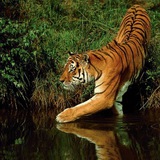
🐅 Tigers have four fangs: two on top and two on the bottom, two on each side of the mouth.
The fangs are mainly used for holding onto prey. They need to be strong as tigers regularly hunt animals larger than themselves.
Читать полностью…


 19368
19368